At What Cost? The Strategic and Moral Dilemmas of Anti-Authoritarian Struggle
My book manuscript examines why social movements fracture under repression instead of unifying around a shared sense of political threat. Drawing on 102 semi-structured interviews, over eight months of participant observation, and 131 survey responses, I examine the Boğaziçi University student movement in Turkey that mobilized for democracy and social justice between 2021-2023. Despite mobilizing side by side in response to the same authoritarian threats, Boğaziçi students split into two factions with similar demographics but different activism styles. One faction adopted confrontational strategies, believing they had to pay a high price for social change if they were going to succeed against an oppressive regime. The other faction adopted playful strategies, prioritizing safety and expression of joy in the face of a regime that restricted most aspects of life.
One of my core findings is that Boğaziçi students’ evaluations of political risk varied based on their analyses of power at the intersection of their ethnic, class, and gender identities. Students reflected on tales of past political struggles and their family histories to evaluate who holds privilege and who faces stigmatization in relation to state power. Consuming heroic tales that celebrate ethnic liberation and labor movements in combination with a perceived family history of complicity in oppression drove students to confrontational tactics. These students understood their affiliation with an elite university as a privilege they can wield; and used confrontation to reckon with their personal and family histories. In contrast, those who grew up listening to cautionary tales about familial experiences of state violence and loss pursued playful strategies that center on community building and humor. Unlike the confrontational group, they viewed social justice movements as a unified front that the Turkish state repressed indiscriminately. By accounting for power and cultural influences, my research contributes to the social movement scholarship at the intersection of sociology and political science. It offers a novel understanding of the relationship between the political structures and meaning-making processes that drive mobilization.
My book also enhances our understanding of youth and parental agency in political socialization by using family member interviews, a method novel for social movements research. Research on political socialization often highlights two main perspectives: intergenerational transmission, which emphasizes the similarities in political values and behavior between parents and youth, and generation effects, which explain the divergences within a family stemming from different life experiences. While the former suggests continuity in political engagement styles, the latter points to a growing distance between younger and older generations. My research bridges these dynamics of social reproduction and social change by demonstrating the agency of parents and young adults in mediating political socialization processes. To understand why young people adopt distinct activism styles, I interviewed not only Boğaziçi students but also their family members, including parents, grandparents, and siblings. My analysis juxtaposes young people’s accounts of their own political socialization with their relatives’ accounts of family history. This approach allows me to discern how political behavior is formed at the intersection of intergenerational transmission and generational shifts.
Additionally, my book puts sociology and peace studies in critical dialogue to explain how strategic and moral dimensions of activism intersect. Sociologists have often examined movement strategies in relation to political and cultural structures, treating morality as an instrument to achieving strategic goals. For example, they argued that public sympathy for a movement will increase following unjust state repression or decrease when a movement resorts to violence. On the other hand, peace studies has emphasized morality, arguing that nonviolence is not only ethically superior to armed resistance but also more effective due to its moral appeal. Interweaving the insights of these fields, my research identifies four dilemmas faced by the Boğaziçi movement concerning both the effectiveness and ethics of recruiting protest participants, the responsibility of protest leaders for participant safety, internal decision-making hierarchies, and cultivating a public image. By examining how young people navigated these dilemmas amid democratic backsliding and heightened political uncertainty, my research shows how activists balance strategic objectives with moral imperatives under repression.
Book Excerpt
On a hot summer day in August 2021, I was headed to an interview with Güneş in Hisarüstü. As I was walking to meet her at a coffee shop on 6th Street, I remembered that the Union of Education and Science Workers (Eğitim-Sen) was going to make a press statement for democratic self-governance that day. Their protest call opened with a critique of the Turkish government: “In the hands of AKP [Justice and Development Party], universities are forced to stand submissively before political power; they have been turned into places managed by kayyums [trustees] with their gates handcuffed, where academics are fired and their robes are trampled by combat boots, laborers are condemned to precarious employment, and students are incarcerated.” The use of vivid imagery and strong wording in political statements was typical of left-wing organizations with socialist or communist orientations.
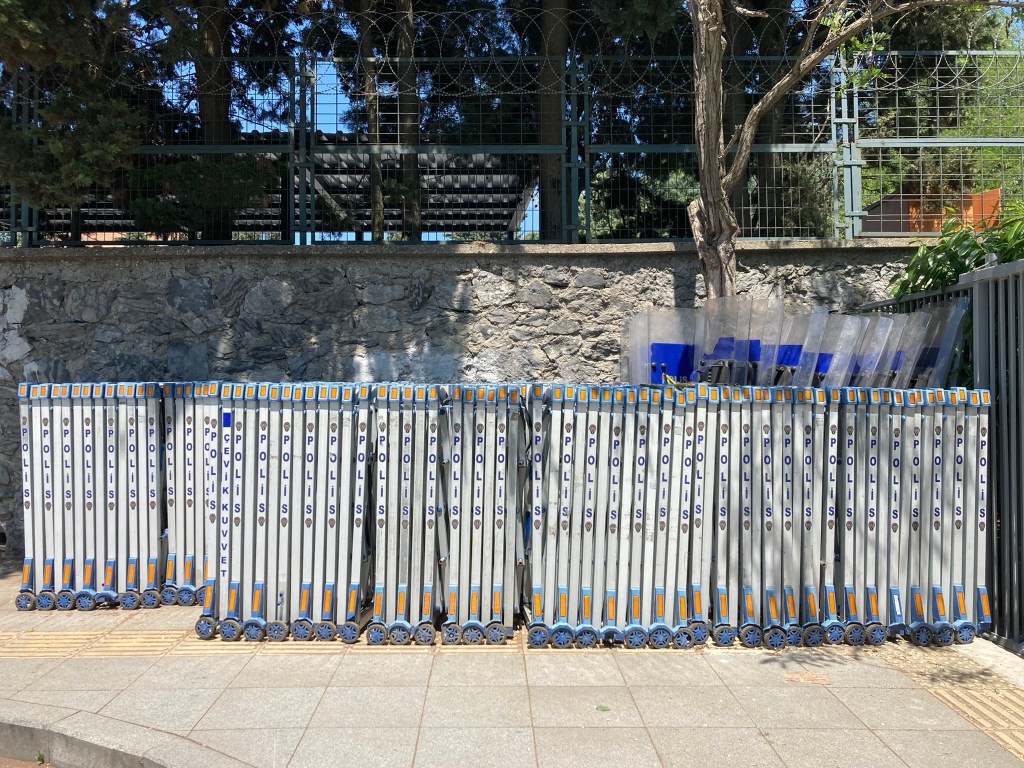
I noticed crowds of people and riot police gathering around the Hisarüstü circle in front of the main gates of South Campus. What used to be a small, green public space had been enclosed with police barricades to prevent people from using the space for demonstrations. Still, the sidewalks were swarming with union members and students. It was a bright day, unnervingly quiet with anticipation as the demonstration was about to start despite alarming police presence.
In case she wanted to attend the protest, I texted Güneş saying that we could postpone. But she wanted to meet. As we were talking in a small café just a couple minutes walking distance from the circle, I could hear the police shouting. Over the course of our conversation, it became clear to me that Güneş had no interest in joining a protest like the one that was happening right outside. She could not imagine herself in agitated crowds and violent encounters with the police. What seemed to be in reference to a famous quote by Emma Goldman, she told me that she does not want a revolution if she cannot laugh and dance with those by her side.[1]
She said,
I’m involved in theater and feminism. Being in an exclusively political organization is very difficult for me. I can’t endure those discussions; I can’t tolerate incidents of [protest leaders] deliberately manipulating the crowd, sometimes to an extent that I would call zealotry. What matters to me is living together, living peacefully; and I have drawn such a path for myself. I mean, if I can’t laugh, can’t have fun with the people next to me, if I’ll feel oppressed, I don’t want your revolution anyway. I think to myself, so what with your socialist revolution? That’s why it is very difficult for me to engage in hardcore struggle in a political organization. […] Until this age, I have been able to express myself doing theater. I really can’t get a megaphone in my hand to pull off an agitating speech. If I am to express myself, let me be in a place suitable for it. And in fact, I am organized in such a place; I am organized in [organization]. It is a culture and arts organization, an organization of actors and musicians. I feel comfortable there, because that’s how I express myself. But I can’t be in political organizations, though I respect them, I can’t be because, I personally -it’s a space where people give up their lives, risk death, and engage in armed struggle from time to time, and to me that’s a huge thing. It seems like a big thing to me. Well, I don’t see myself as that big, so I am often not in those spaces. I support from the outside, but not when they manipulate and mislead masses to advance their own struggle.
As someone who does theatre, Güneş was familiar with performance. Political performance that she recognized as “manipulative” made her uneasy. In her mind, “hardcore” engagement with politics, and politics only, was in stark contrast with the creative and joyful forms of expression she felt comfortable with. From the very first day onward, she used her artistic and organizing skills to contribute to the Boğaziçi movement, including the production of a festival on the fifth day of the resistance. The festival included a concert where students sang a folk song, Yuh Yuh (Boo Boo), with new lyrics arranged by members of the music club.[2] Videos of students singing and dancing in the main quad of South Campus, chanting “Boo Boo” at the regime and its trustees, took over social and news media. A magazine compared the “courage, rage, joy and love” students expressed at the concert to the spirit of the 2013 anti-government Gezi protests. To praise the “determination and creativity” of Boğaziçi students “despite violence, intimidation and defamation,” the piece referred to a James Baldwin quote, saying that “the world is held together by the love and passion of a very few people” [3].
Soon enough, I would meet Elif, who had a quite different view of activism than Güneş. She supported the festive endeavors and respected the “huge labor” her friends put into them. However, she did not think they were political enough in a socialist sense of the word. She preferred actions that prioritized “politicizing” the resistance. She explained that, by politicization, she meant linking the Boğaziçi movement to broader sociopolitical issues in Turkey to promote deeper political awareness among students and the broader public.
Since the Boğaziçi resistance began, since Melih Bulu [trustee rector] was appointed, a case was made against HDP [People’s Democratic Party, i.e. pro-Kurdish party] to close the party, and Turkey withdrew from the İstanbul Convention [a women’s rights convention among European countries], and so on. I actually think Melih Bulu’s appointment was not a subjective event on its own but is interconnected with all of this. […] Politicization means highlighting the connections between these events, conveying this understanding to our fellow activists leading the resistance, and presenting it to the media as such, indicating that we’re speaking to all of these issues. And of course, now almost all of Turkey has embraced the Boğaziçi resistance. I mean, except for the government supporters and similar factions. Perhaps the Turkish people who would not normally defend HDP, the İstanbul Convention, LGBTI+ individuals, have embraced the cause of Boğaziçi. Because this is a school that they love with professors that they respect. With the momentum we’ve accumulated here, we’ve worked to channel our support in that direction.
In contrast to Güneş’s aversion to “hardcore” politics, Elif explained that confronting the state and even getting detained could be useful for a movement.
I think getting detained occasionally can be necessary, can be beneficial. I mean, beneficial for the protest, for the movement. Same goes for an arrest too. Of course, it is wrong to call it beneficial. But what I mean is that these have some positive consequences for the movement like increased media visibility, rekindling the issue, and so on.
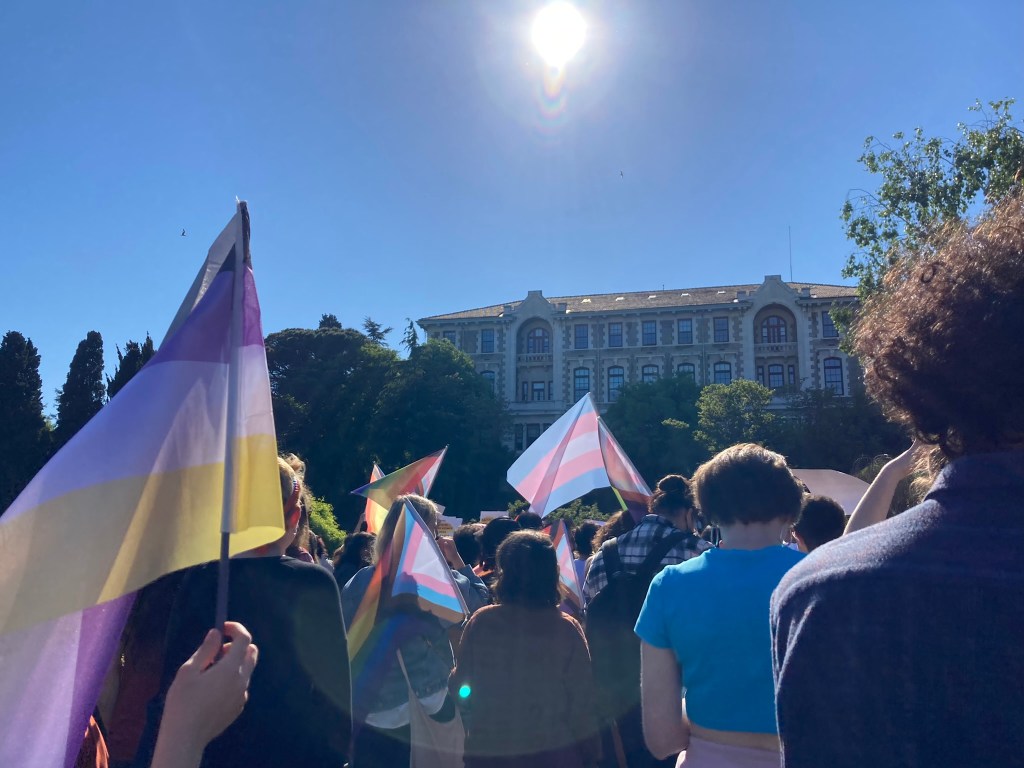
Elif was wary of portraying detentions in a fully positive light. But she still thought that, as long as people were aware of what they were walking into, there was nothing wrong with carrying out a “detention protest,” a term Boğaziçi activists used to refer to protests organized (often purposefully) with the awareness that the risk of detention was very high. She recounted a time when she attended a Pride march in Germany, where even the police were dancing. However, protesting in Turkey, she said “is truly like we’re going to war.” Therefore, she saw more utility in organizing explicitly political protests that confront the government.
By comparing the cases of activists like Güneş and Elif my book examines why young people engage with political risk differently, explaining why these differences fracture movements under repression.
[1] Emma Goldman was an anarchist and feminist political activist. Güneş did not name Emma Goldman. Instead, she said, “you know, like that saying, ‘it’s not my revolution if I can’t dance to it.’” This quote by Emma Goldman is referenced by feminist platforms in Turkey frequently enough that it is possible Güneş had heard of it before.
[2] https://youtu.be/LWBApy7v8Cw?feature=shared
[3] https://roarmag.org/essays/turkey-bogazici-university-student-protest/
 Şehrazat G. Mart, Ph.D.