Social Mobilization During Democratic Backsliding
My primary research examines the dynamics and outcomes of social mobilization in Turkey, in a context of democratic backsliding.
See my book project At What Cost? or articles in-progress, titled Implementing Authoritarian Policies and What do Movement Members Owe to Each Other?.
GATEKEEPING in FIELDS OF KNOWLEDGE PRODUCTION
My second agenda examines patterns of exclusion in knowledge production, in academia and other transnational professional fields.
See my publications Imagined Interventions and Peace Scholarship and the Local Turn or article in-progress, titled The Students Denied.
Peer-Reviewed Publications

Imagined interventions: Critical-Ideational Strategies across Multiple Futures in Public Interest Scenarios
2025, Time & Society – Volume 34, Issue 1
with Ann Mische
Abstract: This paper examines the critical-ideational strategies of public interest scenario projects seeking to intervene in urgent problems related to democracy, development, peacebuilding, and climate change. As cultural technologies for foresight in turbulent times, scenario methodologies direct attention to the temporal multiplicity and contingency of action; they engage diverse ensembles of actors in challenging conversations to identify alternative ways in which futures could unfold. These methods are grounded in pragmatist and phenomenological theories of time and imagination. However, they are not merely speculative exercises, but make political-normative interventions that attribute blame for problems and credit for solutions to state, market, or civil society actors. By distributing responsibility across temporally multi-pronged narratives, these projects stake out positions on the long-term trajectories of capitalism and democracy. Through a textual analysis of the allocation of blame and credit in 29 scenario projects focused on the African context (1991–2017), we examine how coalitions of local and transnational actors harness the uncertainty and multiplicity of futures to imagine, critique, and affirm different kinds of sociopolitical interventions. We compare how different “genres” of scenario projects refract the future into story-sets of continuity, constraint, collapse, and transformation. This temporal splitting enables them to wrestle with trade-offs and incorporate diverging perspectives while making strong overarching claims about the desirability of certain lines of action over others. In this way, scenario coalitions position themselves in relation to core debates about the relative role of the public, private, and civic sectors in causing and responding to the crises of our times.
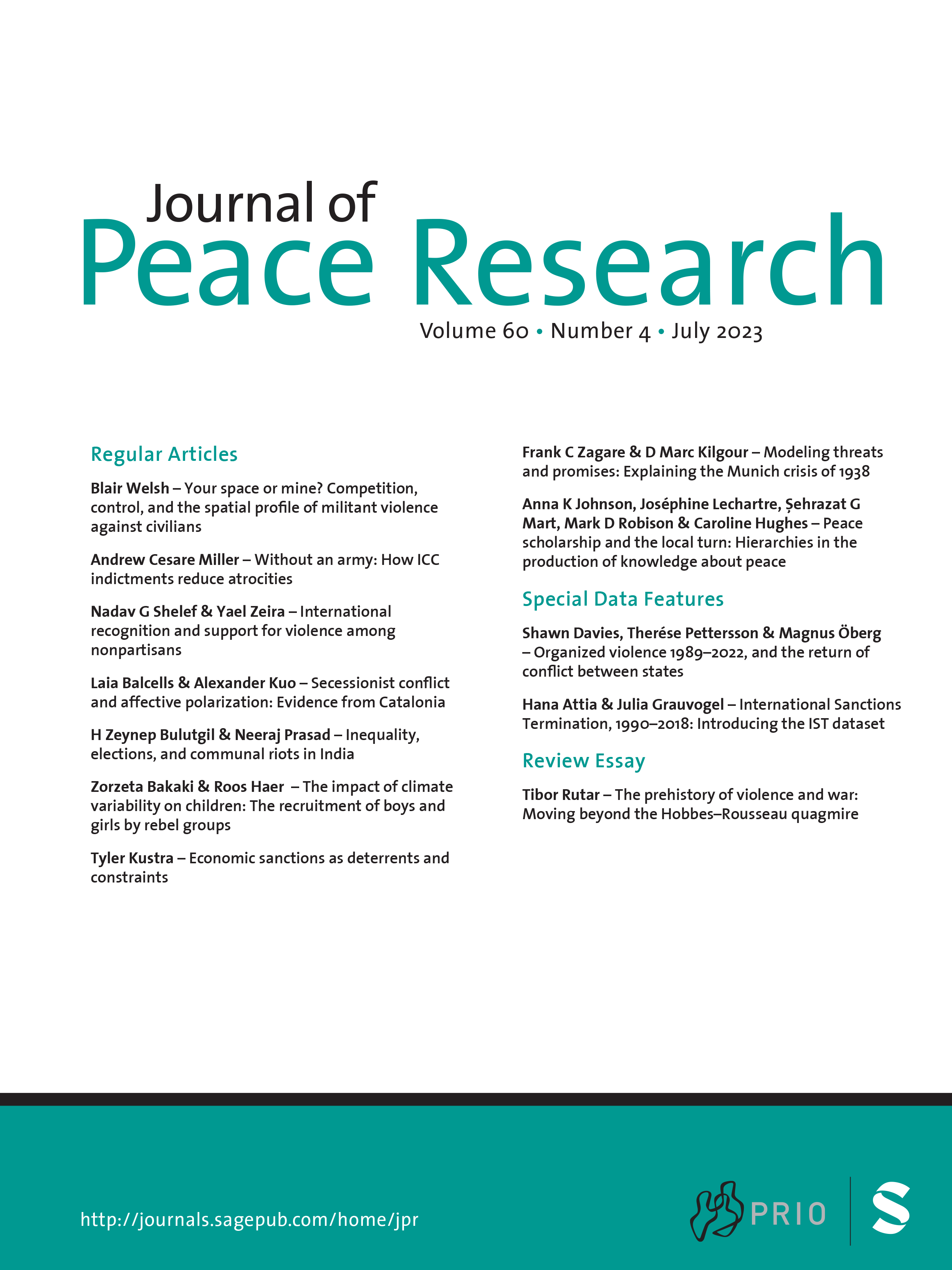
Peace Scholarship and the Local Turn: Hierarchies in the Production of Knowledge about Peace
2023, Journal of Peace Research – Volume 60, Issue 4
with Anna K. Johnson, Joséphine Lechartre, Mark D. Robison and Caroline Hughes
Abstract: The ‘local turn’ in peacebuilding has focused attention on the importance of cultural resources available for peacemaking in ‘local’ conflict-affected contexts, and particularly in non-Western countries. Growing attention is now also paid to establishing whether the academic field of peace studies itself is inclusive of non-Western voices and perspectives. This article presents a new dataset of 4,318 journal articles on peace indexed in Web of Science between 2015 and 2018 to discover asymmetric patterns of publication and scholarly gatekeeping between higher-income and lower-income countries. Analysis of the data collected suggests that 15 years after the ‘local turn,’ higher-income countries continue to dominate the field across the domains of publishing institutions; scholarship about non-high-income countries; the conduct and focus of research collaborations; claims to theorization; and the discourse of the field. However, positive change is being driven by a proliferation of scholarship in upper-middle-income countries, characterized by intranational collaborations between scholars writing about their own countries in their own national journals.
Articles in Progress &Under Review
Implementing Authoritarian Policies
Winner of the Jeanine A. Becker Memorial Award for the Most Outstanding Paper from the Department of Sociology at the University of Notre Dame
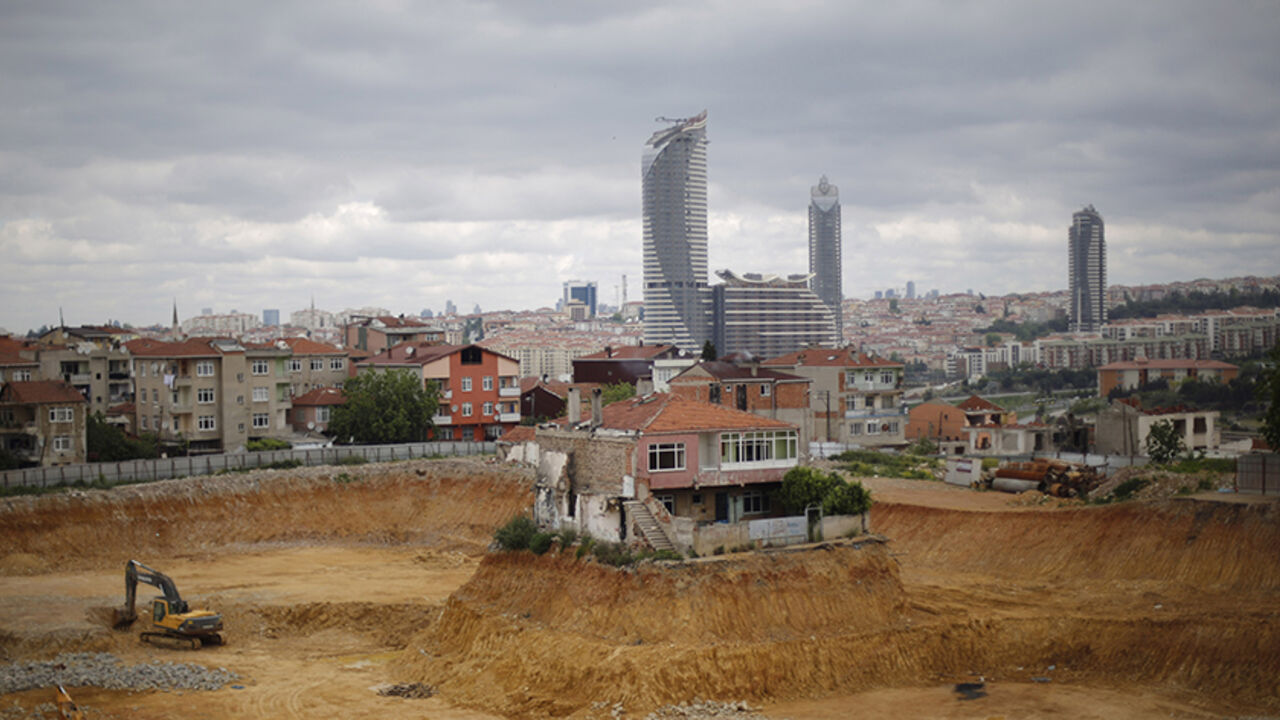
In Turkey, ‘urban transformation projects’ are implemented at the intersection of disaster preparation and mass housing policies. On paper, these government-led and large-scale projects prepare cities for future earthquakes by demolishing neighborhoods at risk and relocating residents to newly developed public housing. In practice, however, the Turkish government exploits urban transformation to seize valuable urban land while uprooting networks of socioeconomic support and political resistance among historically marginalized communities
The government’s authoritarian urban strategy gets traction in Turkey’s contemporary democratic backsliding trend, marked by cumulative institutional changes that have centralized power while weakening public accountability and opposition. However, even in regimes where power is consolidated in the hands of a few, the ruling elite do not carry out policies themselves; bureaucrats do. How bureaucrats interpret and put policies into practice—namely, bureaucratic discretion—determines how public goods and services are delivered at the “street level.”
Drawing on rare interviews with municipality and ministry officials implementing urban transformation projects in Turkey as well as an expansive document analysis this article answers the following question: in an increasingly authoritarian policy arena, what constraints and opportunities shape bureaucratic discretion for public-spirited implementation?
First, I argue that centralized, reactive, inconsistent, coercive, and ambiguous qualities of policymaking during democratic backsliding hinder effective and public-spirited implementation. Secondly, I argue that organizational characteristics—including work experience, autonomy from the central government, and ethos—influence how bureaucrats exercise discretion under policy turbulence. Thirdly, I argue that the perception of citizens as political agents—facilitated by an organizational critique of profit-oriented policy priorities and disruptive public resistance against projects—compel bureaucrats to adopt consultative measures. Overall, I find that, in an increasingly authoritarian setting, severe constraints coexist with meaningful opportunities for public-spirited implementation. Organizational characteristics and the perception of citizens influence whether bureaucrats yield to these constraints or build on the opportunities.
What Do Movement Members Owe to Each Other?
This article focuses on the dilemmas of recruiting protest participants and the responsibility of protest leaders for participant safety. Bogazici movement organizers disagreed over whether encounters with the state’s violent response in the streets or peer learning and community building in a buffer zone like a university campus would drive political awareness and sustained participation. They also disagreed on whether protest leaders needed participants’ “consent” to host a protest if they suspected risk of violent intervention or if it was “victim-blaming” to hold organizers responsible for the violence perpetuated by the state. This article examines the causes of these moral predicaments and why students navigated them in distinct ways.
The Students Denied
In a project in-progress, I surveyed approximately 500 students from twenty sociology programs in the U.S. to examine how course design and content in theory classes shape student experiences at the intersection of race, gender, and class. For example, I find that women’s sense of belonging within the discipline decreased substantively after taking theory courses that prioritized the traditional canon, whereas men’s increased. Additionally, 47% of Black students reported that classical theory courses negatively impacted their sense of inclusion. My research shows that situating the canon historically and pairing original texts with contemporary critiques are necessary for an inclusive learning environment. Based on this finding—and other results from the survey—I designed a theory syllabus that fosters critical and comparative engagement with diverse perspectives.
 Şehrazat G. Mart, Ph.D.